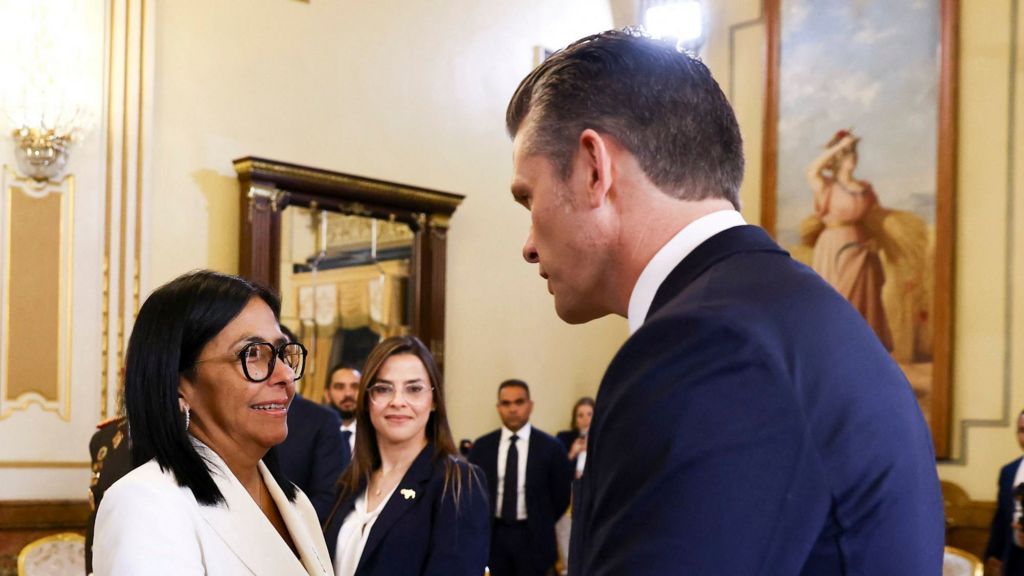
In a significant geopolitical move, the United States and Venezuela have rekindled their military relationship, barely a year after a US-led operation ousted former Venezuelan leader Nicolás Maduro. The interim government of Delcy Rodríguez, Maduro's former vice-president, signed a military cooperation agreement with US Secretary of Defense Pete Hegseth on Wednesday. Few details have been disclosed about the accord, but Hegseth highlighted that Venezuela has transitioned from being a "most aggressive regional threat" to a "compliant security partner." Rodríguez emphasized that the deal would aid in countering common threats. The military alliance was dissolved in 2005 by Hugo Chávez, Maduro's predecessor, who accused US troops of making disparaging remarks about his government and being a CIA operative. Under Maduro's rule, relations between the two nations deteriorated further, culminating in the US offering a $50 million reward for information leading to Maduro's capture in late 2020. Maduro and his wife, Cilia Flores, are currently detained in New York on charges of drug-trafficking and conspiracy to commit torture that they deny.
During his speech at the US embassy in Caracas, Hegseth acknowledged the transformation in the two nations' relationship since Maduro's capture. He stated, "Just one year ago, my presence here would have been deemed impossible, almost unimaginable." Hegseth also referenced a public appearance by then-President Maduro that angered the Trump administration. The agreement signed by Hegseth and Venezuela's defense minister on Wednesday was described as a "new chapter" for both nations and the Western Hemisphere through the Americas Counter Cartel Coalition by Hegseth. Rodríguez regarded it as "extraordinarily relevant for our bilateral relations."
While specifics of the deal have yet to be released, Rodríguez mentioned the training of Venezuela's armed forces and improving their operational equipment and access to new technology "to confront shared threats" in her speech. Hegseth was more direct about the threats he considers in his speech at the US embassy, warning "narco-terrorists who abuse this [Venezuela] as a safe haven" that "we will hunt you down, we will find you, and we will kill you." Following his visit to Venezuela, Hegseth traveled to neighboring Colombia, where he reinforced the US-Colombian partnership as being stronger than ever before. Colombia is already part of the US-led Americas Counter Cartel Coalition, and there have been discussions about potential joint operations against armed groups. However, Colombian President Abelardo de la Espriella denied reports that he had rejected carrying out joint operations, stressing that any decision would be taken while respecting Colombia's constitution, laws, and sovereignty.