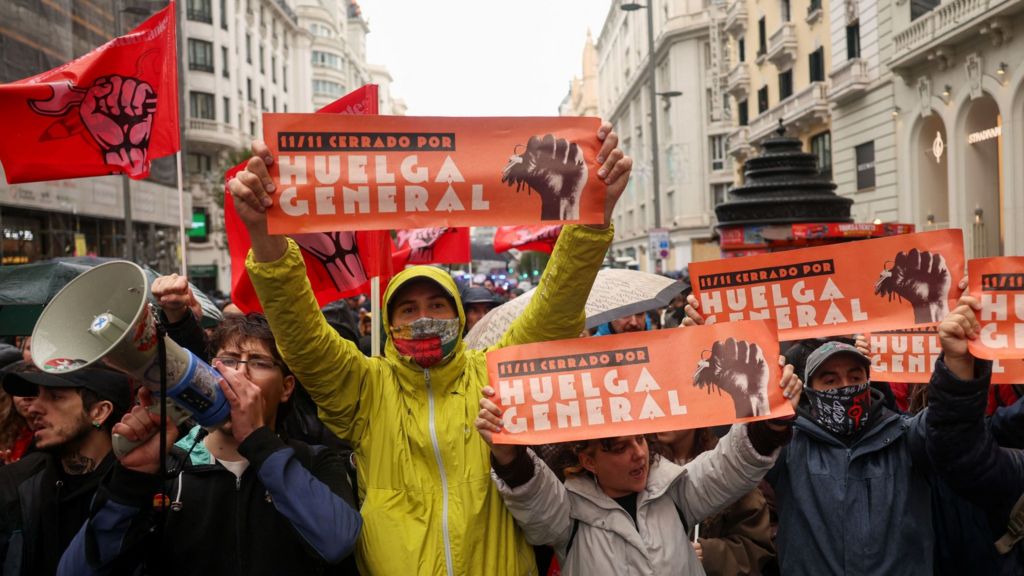
Spain has experienced widespread disruption as the country's main unions called for a general strike over issues related to housing and the high cost of living. This is the first such strike in 14 years, taking place less than three weeks before Spain's parliamentary elections scheduled for November 29. Demonstrations are planned across major cities, with the biggest expected in Madrid and Barcelona. The unions UGT and CC OO reported "massive" and "very significant" participation respectively, while the Spanish Confederation of Business Organisations described turnout as "low and uneven." Protests were sparked by the eviction of an 87-year-old woman from her home in Madrid after a tripling of rent under new landlords. The strike has caused significant disruption in main industrial hubs such as Madrid and Catalonia, with traffic halted on several major roads. Dozens of people were arrested for various incidents, and some estate agencies reported attacks on their offices.
The Socialist Prime Minister Pedro Sánchez called snap elections last month after parliament failed to approve his plan for housing reform. While previous strikes have been problematic for the government in power, Sánchez has encouraged workers to strike and praised those who participated in earlier strikes. The conservative People's Party (PP) accused the government of attempting to weaponize the strike for electoral gain, with party leader Alberto Núñez Feijóo calling the unions "mafia" and "trash." Gonzalo Álvarez, a 27-year-old sales worker who volunteered for a housing union, shared his support for the strike, citing the eviction of Maricarmen Abascal as the catalyst for the protests.
The vice-president of the CEOE, Miguel Garrido, criticized the strike, arguing that businesses had little to do with the price of housing. The scale of support for the strike will be seen as an indicator of public discontent ahead of the election, and a drop in power usage during the early hours of Wednesday indicates significant industrial participation in the strike. During the last general strike 14 years ago, equivalent consumption was down by more than 15%.