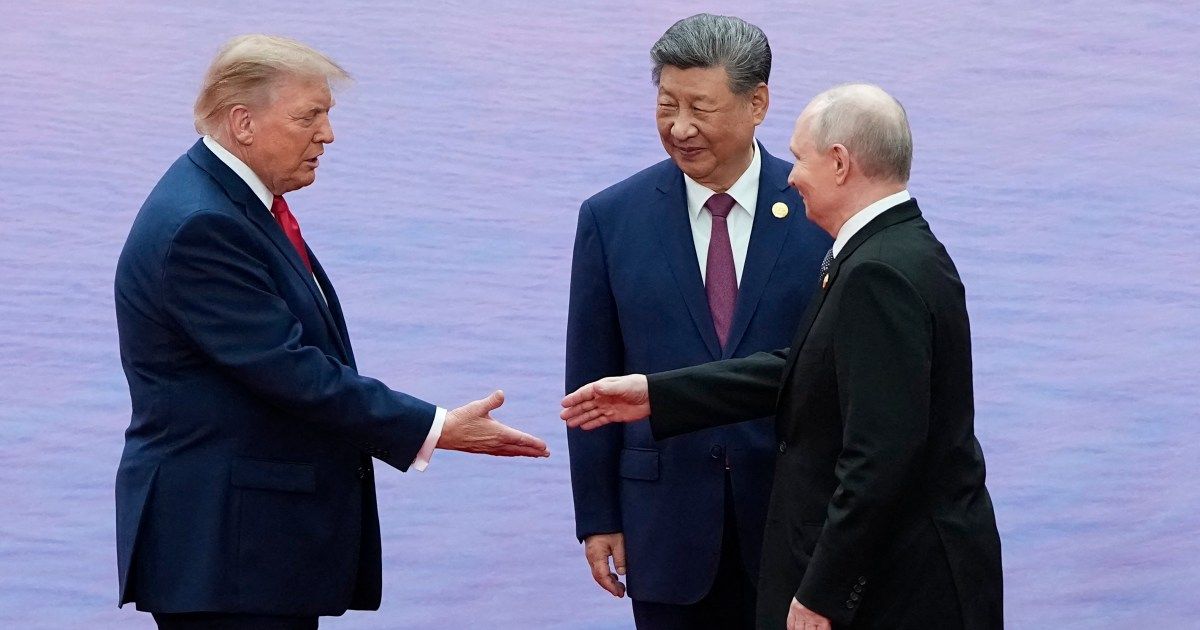
US President Donald Trump, Chinese President Xi Jinping, and Russian President Vladimir Putin will convene for their first three-way meeting on Thursday in the southern Chinese city of Shenzhen. This summit, taking place during the Asia-Pacific Economic Cooperation (APEC) leaders' summit, hosted by China on November 18 and 19, has drawn comparisons to the Yalta conference of 1945, where the United States, the United Kingdom, and the then-Soviet Union agreed on post-war order. However, unlike the Yalta Conference, these leaders are arriving with different goals, and few concrete outcomes are expected.
The meeting comes after Trump attended the Association of Southeast Asian Nations (ASEAN) meeting in Manila and Xi's warm welcome at the airport upon Trump's arrival in Shenzhen on Wednesday. The White House has revealed that Trump plans to discuss the war with Iran, as well as a potential three-way agreement on nuclear armament with Xi and Putin. Ukraine is not anticipated to be on the formal agenda due to Xi's reluctance to involve himself in what he views as a European matter.
Tensions remain despite the truce agreed upon in October 2025, which has been extended until January 10, 2027, for broader trade talks. Friction between the US and China persists over issues such as rare earth mineral exports and the alleged diversion of Nvidia chips to China. Expectations are low for a major thawing, with a handshake without incident potentially being seen as a win.
Meanwhile, Trump's special envoys, Steve Witkoff and Jared Kushner, have brokered talks between Russia and Ukraine in Abu Dhabi on November 10 and 11, marking the first direct talks since February. The pair has visited both Kyiv and Moscow to promote these discussions. Trump's rhetoric towards Putin has softened recently, but he has publicly criticized Ukrainian President Volodymyr Zelenskyy for targeting Russian energy facilities and driving up global oil prices.
The Shenzhen meeting will offer insight into the shifting alliances and tensions between these world powers, as they navigate a complex geopolitical landscape. The outcome of this historic summit remains uncertain, but its implications are significant for global stability and economic growth.